Contact: ☎ 973-405-6248 | ✉ sales@Iron-Powders.com

What is Zaro-Valent Iron (ZVI)?
Pure iron powder—most commonly known as zero-valent iron (ZVI)—is a workhorse material in in-situ ground and groundwater remediation, especially for sites contaminated with chlorinated solvents and certain metals. By specifying the term zero-valent we distinguish pure iron powder from iron compounds and many iron alloys.
What is iron powder doing in remediation?
Iron powder is used as a chemical reducing agent. When metallic iron (Fe⁰) is placed in soil or groundwater, it corrodes:
Fe0 → Fe2+ + 2e−
Those released electrons break down contaminants into less toxic or non-toxic compounds.
Key contaminants treated with iron powder
1. Chlorinated solvents (biggest use)
Examples:
- Trichloroethylene (TCE)
- Tetrachloroethylene (PCE)
- Vinyl chloride
- Carbon tetrachloride
Mechanism:
Reductive dechlorination — chlorine atoms are stripped off and replaced by hydrogen.
End products:
Ethene, ethane, chloride ions (harmless at environmental levels)
2. Heavy metals & metalloids
Iron powder helps by chemical reduction + immobilization.
| Contaminant | Effect |
|---|---|
| Chromium (Cr⁶⁺) | Reduced to Cr³⁺ (far less toxic, insoluble) |
| Arsenic | Adsorbed onto iron oxides |
| Lead | Immobilized as insoluble compounds |
| Uranium | Reduced to immobile U(IV) |
3. Nitrates & some pesticides
- Nitrates → ammonium or nitrogen gas (site-dependent)
- Certain explosives (TNT, RDX) can also be degraded
How iron powder is deployed in the field?
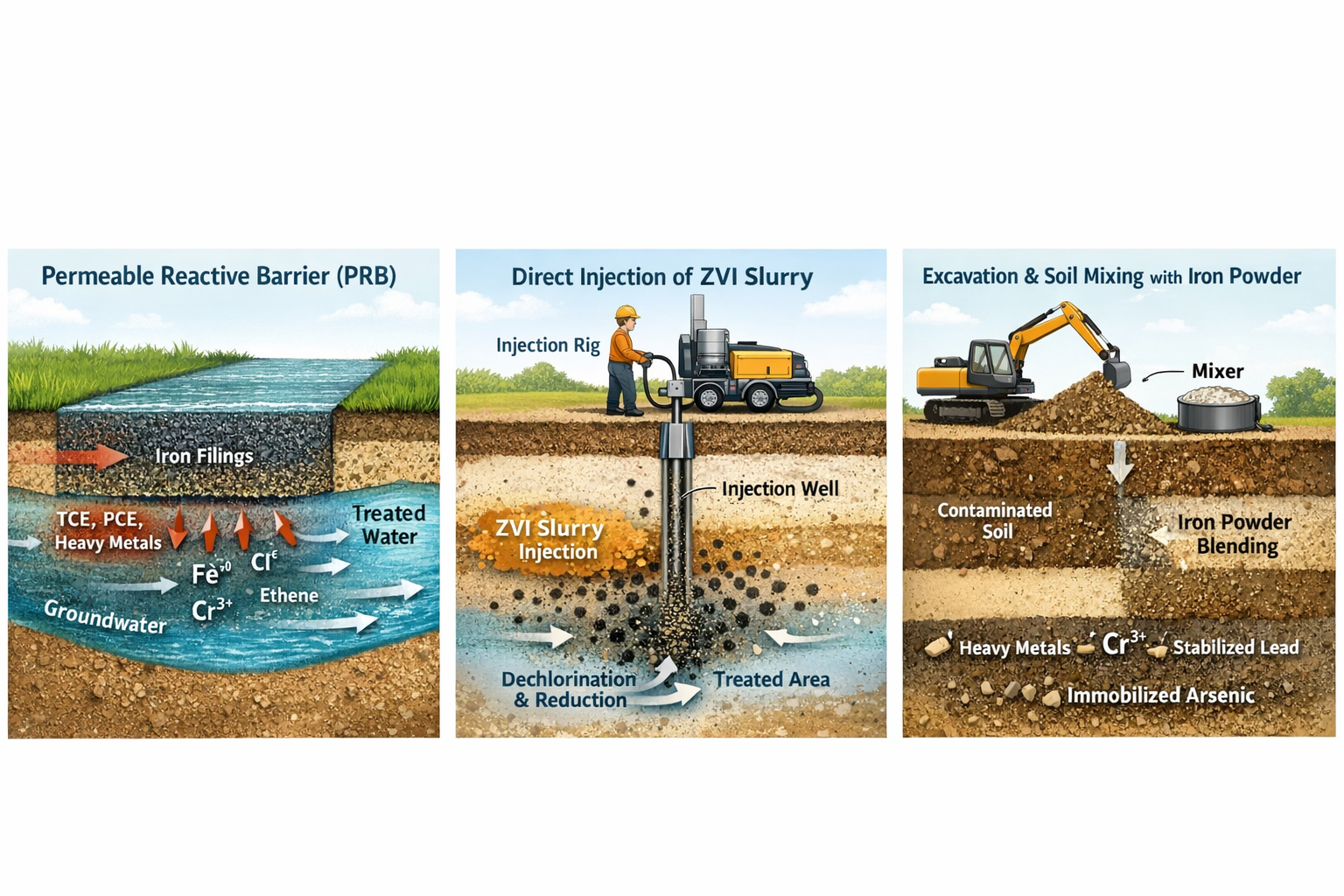
1. Permeable Reactive Barriers (PRBs)
- Trench filled with iron filings
- Groundwater flows through the iron
- Passive, long-term (10–30 years)
Typical iron form:
Coarse iron filings (0.25–2 mm)
2. Direct soil or groundwater injection
- Iron powder slurried with water (sometimes polymers)
- Injected via wells or direct-push rigs
Typical iron form:
- Fine iron powder (10–100 µm)
- Stabilized nano-iron (nZVI)
3. Excavation + blending
- Contaminated soil removed
- Iron powder mixed mechanically
- Soil replaced or stabilized onsite