Contact: ☎ 973-405-6248 | ✉ sales@Iron-Powders.com

Making Iron Slurry
To turn iron powder into a pumpable, injectable slurry, you typically add water plus one or more stabilizing / conditioning additives. The goal is to keep iron suspended long enough to inject it without settling, clogging, or excessive aggregation.
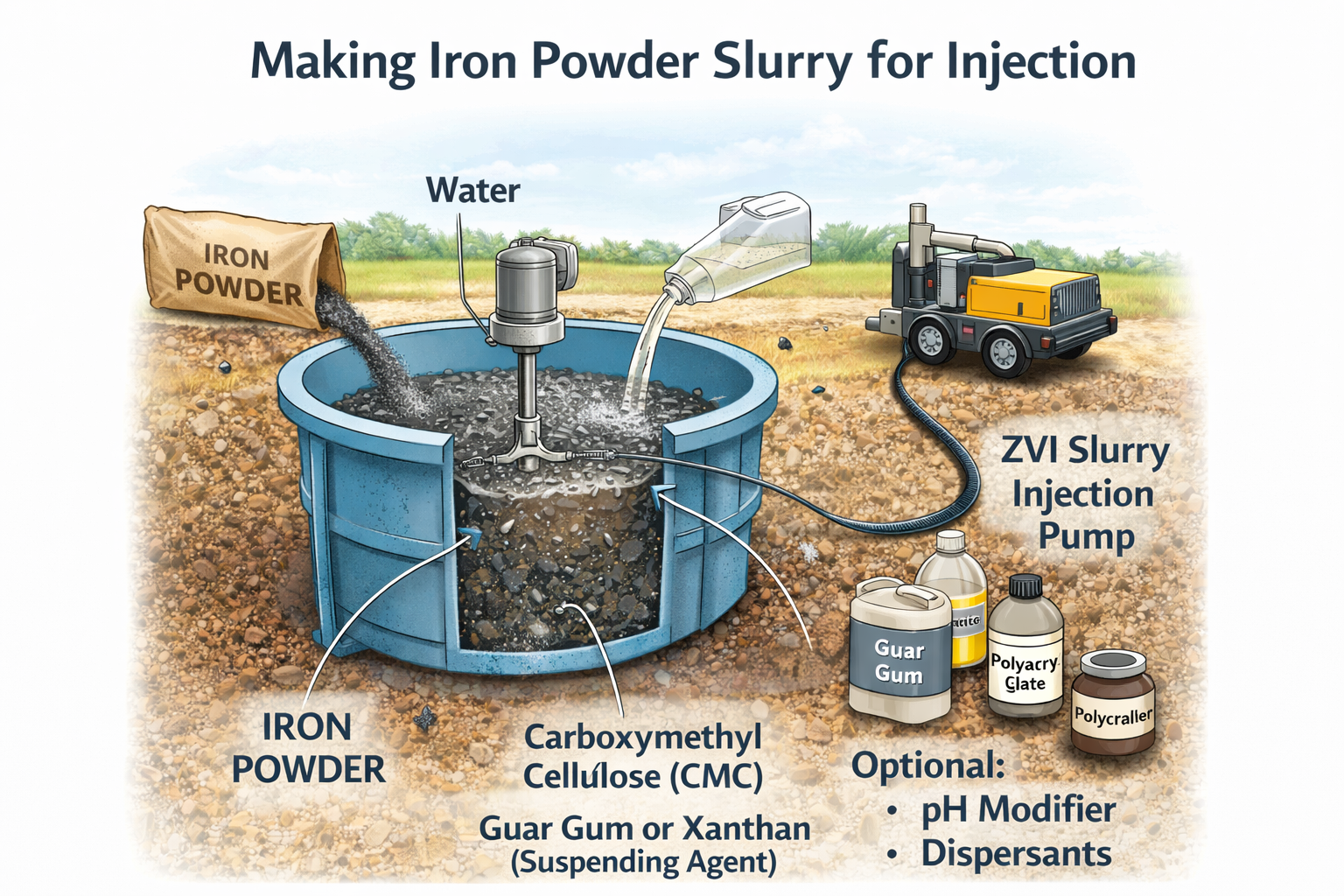
Core components of an iron slurry
1. Water (carrier fluid)
- Usually potable or site groundwater
- Typical solids loading:
- 1–10 wt% iron for injection
- Higher solids = harder to pump
Water alone is not sufficient for most fine iron powders.
Common additives used in iron slurries
2. Suspending / thickening agents (most important)
These slow settling and improve injectability.
Common options:
- Carboxymethyl cellulose (CMC)
- Most widely used for ZVI slurries
- Excellent suspension stability
- Low cost, biodegradable
- Guar gum
- Natural polysaccharide
- Good short-term suspension
- Breaks down biologically after injection
- Xanthan gum
- Very stable over wide pH range
- Higher viscosity at low concentrations
Typical dosage:
👉 0.1–0.5 wt% of slurry
3. Dispersants / stabilizers (especially for fine or nano iron)
Used to prevent iron particles from clumping.
Common choices:
- CMC (dual role: thickener + stabilizer)
- Polyacrylate dispersants
- Low-molecular-weight organic acids (citric, acetic – site dependent)
These are critical for fine and porous iron powders.
4. pH modifiers (optional)
Used to optimize performance or compatibility with groundwater chemistry.
- Sodium bicarbonate
- Mild buffers
⚠️ Strong bases (NaOH, lime) are usually avoided—they cause rapid iron passivation.
5. Biological enhancement additives (optional)
Sometimes iron is combined with carbon sources:
- Emulsified vegetable oil (EVO)
- Lactate or molasses
This creates a combined chemical + biological remediation system.
What is not recommended
Avoid adding:
- Surfactants not approved for subsurface use
- High-salt solutions (can destabilize slurry)
- Strong oxidizers
- Cementitious materials (unless immobilization is the goal)
Typical iron slurry formulation (example)
General-purpose ZVI slurry:
- Water: balance
- Iron powder (e.g., IRON100): 2–5 wt%
- CMC or guar gum: 0.2–0.4 wt%
- Optional dispersant: ≤0.1 wt%
This formulation is:
- Pumpable
- Injectable
- Stable for several hours
- Compatible with direct-push or well injection
Fast-reacting vs slow-reacting slurry behavior
| Iron type | Slurry behavior |
|---|---|
| Fine, porous iron | Needs stabilizer, reacts fast |
| Medium iron (IRON100) | Easy to slurry, balanced |
| Coarse / dense iron | Settles quickly, limited injection use |
Publish-ready wording you can use
You may use this verbatim on your site:
“Iron powder slurries are typically prepared using water as a carrier fluid and small amounts of suspending or stabilizing agents such as carboxymethyl cellulose (CMC), guar gum, or similar biodegradable polymers. These additives help keep iron particles evenly suspended during pumping and injection, allowing effective delivery into soil or groundwater treatment zones.”